Stop Paying for AI Agent Memory
The AI agent memory market hit $6.27 billion this year. Mem0 wants $249/month for graph features. Zep killed their self-hosted Community Edition and moved to cloud-only credit billing. Letta charges per agent. Everyone wants you in their cloud, topping up “memory credits.”
Here’s the question nobody asks before signing up: what happens to your memory when you stop paying?
Your accumulated context is everything that makes you unique. Every entity, every learned preference, every relationship your agent built over months, lives inside their system. That’s now your switching cost. Your memory is what makes your agent useful instead of starting from zero. And it’s locked inside someone else’s billing page.
Meanwhile: PostgreSQL is free. pgvector is a free extension. Your AI subscription already includes conversational memory. Markdown files cost nothing. Cron jobs are free locally. My total infrastructure cost is $0–7/month vs. $249–475/month for a managed framework. Here’s what actually works.
The 5-Layer Architecture
I landed on five layers. Each one handles a different type of recall. No single layer replaces any other.
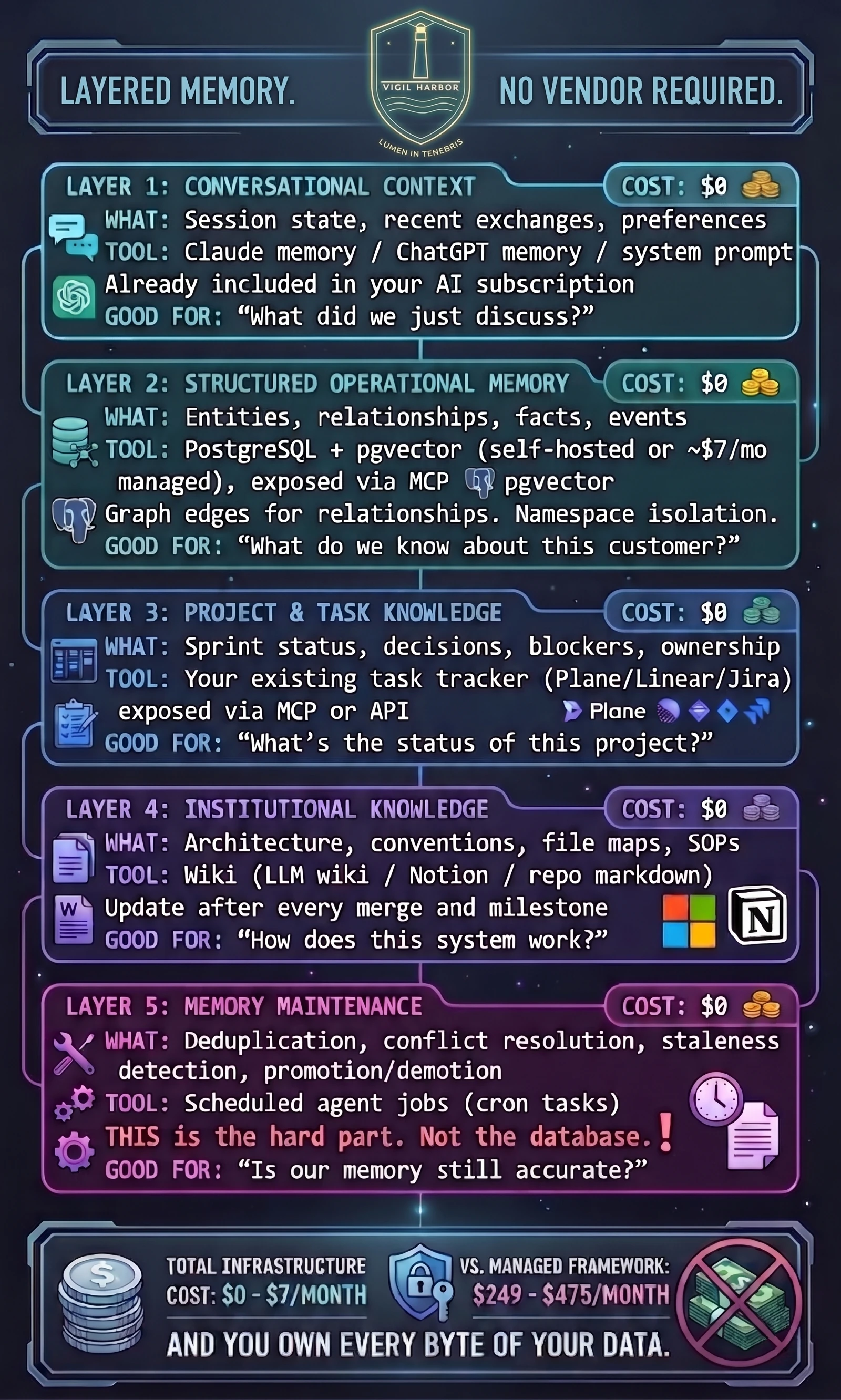
Layer 1: Conversational Context — Cost: $0 Session state, recent exchanges, preferences. This is Claude memory, ChatGPT memory, your system prompt. Already included in your AI subscription. Good for: “What did we just discuss?”
Layer 2: Structured Operational Memory — Cost: $0–7/month Entities, relationships, facts, events. I use PostgreSQL + pgvector. It handles structured queries, vector similarity search, and full-text search in one system. Expose it via MCP (Model Context Protocol) with namespace isolation per user/client. Graph edges for relationships. Good for: “What do we know about this customer?”
Don’t freak out; Claude can build one of these in one shot. It’s like the Skyrim of databases. Endlessly moddable and battle-tested. You don’t need anything fancy. The trick is tailoring it to what you need. I run about 10 MCP tools in ~2K lines of TypeScript: one for semantic search, one for structured filtered retrieval, one for graph edge navigation, one for upserts, etc. Just upload this post, it’ll ask some questions and build it for you.
Layer 3: Project & Task Knowledge — Cost: $0 Sprint status, decisions, blockers, ownership. Your existing task tracker (Plane, Linear, Jira) exposed via MCP or API. Don’t duplicate this into your memory database — it already lives somewhere. Just give your agent access. Good for: “What’s the status of this project?”
Layer 4: Institutional Knowledge — Cost: $0 Architecture decisions, conventions, file maps, SOPs. Wiki pages, repo markdown, Notion — whatever you already use. The key discipline: update after every merge and milestone. This is where your agent learns how your system works, not just what’s in it. Good for: “How does this work?”
Layer 5: Memory Maintenance — Cost: $0 Deduplication, conflict resolution, staleness detection, promotion/demotion. This is the hard part. Not the database. I use an agent cron job for daily linting and audit reports, then a second agent picks those reports up and operates on them. Two-job file-based handoff always. Research writes to disk, delivery reads from disk. It’s not perfect, but it’s working.
Without active maintenance, every memory system degrades within weeks regardless of how sophisticated its retrieval is. The managed frameworks mostly handle this poorly; Mem0’s implicit preference accuracy benchmarks at 30–45% on behavioral inference. “Intelligent forgetting” in most frameworks is just TTL expiration or recency pruning. Neither understands domain relevance, your specific knowledge you want to keep regardless of the policy.
What You’re Actually Paying For
Strip away the branding and pricing tiers, and every memory framework sells you four things:
- A database with vector search. PostgreSQL + pgvector does this for free with ACID guarantees.
- A retrieval layer. “Intelligent retrieval” is mostly hype. A well-structured pgvector similarity query gets you 80% of the way. The remaining 20% you might want, temporal reasoning, graph traversal, multi-hop, this only matters for specific use cases and most agents don’t need $249/month of it.
- An extraction pipeline. Genuinely useful, but it’s an LLM call with a structured output prompt. You can build entity extraction in an afternoon. That’s not $249/month of engineering.
- Lifecycle management. This is what they should charge for, because it’s the hardest to get right. But ironically, most frameworks do it badly.
The Data Portability Test
Before you commit to any memory system, ask three diagnostic questions:
- Can I export everything in a standard format tonight?
- Does it still work if the vendor disappears tomorrow?
- Can I move it to a different system without rebuilding from scratch?
PostgreSQL passes all three. Markdown files pass all three. Your task tracker passes all three. Most managed frameworks fail at least one.
Honest Caveats
- This does take some engineering time upfront, easier with a coding agent of choice. If you’re a solo developer who just needs something working today, Cognee (open source, local-first, graph at every tier — genuinely good) might be the right starting point.
- The maintenance layer (Layer 5) is genuinely hard. I’m still iterating on mine. There’s no silver bullet for conflict resolution and decay.
- If you need enterprise compliance (SOC 2, HIPAA), a managed platform gives you those checkboxes faster than self-hosting.
Don’t build in someone else’s system just to accumulate into switching costs later. The most valuable asset for AI agents is your accumulated operational context; it directly effects their ability to work with “make no mistakes”. They’ll already know which mistakes you’re talking about. Take the time to build your own brain so no one can take it away from you.
Total infrastructure cost: $0–7/month. You own every byte of your data.
Happy to answer questions about the implementation. We open-sourced our MCP security layer (Drawbridge) and might do the same with parts of the memory tooling.
Frequently Asked Questions
How much does AI agent memory actually cost?
Most managed frameworks cost $200–475/month at production scale. Mem0 charges $249/month for graph features. Zep Cloud runs $25–475/month on credit-based billing. Letta charges $20–200/month per agent. Self-hosted alternatives using PostgreSQL with pgvector cost $0–7/month for equivalent functionality — the tradeoff is engineering time upfront instead of recurring licensing fees.
What's the cheapest way to build AI agent memory?
PostgreSQL with pgvector. It handles structured queries, vector similarity search, and full-text search in one free, open-source system. Pair it with your AI subscription's built-in conversational memory (Claude, ChatGPT), your existing task tracker for project knowledge, and a wiki or markdown repo for institutional knowledge. Total software cost: $0–7/month. The main investment is a few days of setup — most coding agents can scaffold a working memory server in a single session.
Should I use Mem0 or build my own agent memory?
Mem0 is convenient but creates vendor lock-in. Your accumulated context — entities, relationships, learned preferences — lives on their infrastructure, and that context is what makes your agent useful. If you stop paying, you lose it. Self-hosting with PostgreSQL gives you the same core capabilities (vector search, entity storage, relationship modeling) with full data ownership and portability. The exception: if you need enterprise compliance checkboxes (SOC 2, HIPAA) immediately, a managed platform gets you there faster.
What is layered memory architecture?
Layered memory architecture splits agent recall across five complementary systems instead of relying on a single framework. The five layers are: conversational context (already included in your AI subscription), structured operational memory (PostgreSQL + pgvector), project and task knowledge (your existing tracker via MCP or API), institutional knowledge (wiki, docs, markdown), and memory maintenance (scheduled jobs for deduplication, conflict resolution, and staleness detection). Each layer handles a different type of recall — no single layer replaces any other.
Is PostgreSQL good enough for AI agent memory?
Yes, for most production use cases. PostgreSQL with pgvector provides structured queries, vector similarity search, full-text search, and ACID transactions in one system. It handles entity storage, relationship modeling via graph edges, namespace isolation per user or client, and full audit trails. The main limitation is that it doesn't provide temporal knowledge graph traversal out of the box — but most agents don't need that, and if yours does, you can add it incrementally rather than paying $249/month for a framework that bundles it.
How do I keep AI agent memory from degrading?
Every memory system degrades within weeks without active maintenance — this is the hardest part of the architecture, not the database. Production memory needs scheduled jobs for deduplication, contradiction detection, staleness auditing, and memory promotion or demotion. A two-job pattern works: one job runs research and writes findings to disk, a second job reads those findings and acts on them. Most managed frameworks handle maintenance poorly; Mem0's implicit preference accuracy benchmarks at 30–45% on behavioral inference, and most 'intelligent forgetting' is just TTL expiration or recency pruning with no understanding of domain relevance.
What happens to my agent's memory if I stop paying for a managed framework?
You lose access to your accumulated context. Managed cloud services store your entities, relationships, and learned preferences on their infrastructure — that data is your switching cost by design. Self-hosted systems (PostgreSQL, markdown files, your own task tracker) give you full data ownership regardless of any vendor relationship. Before committing to any memory system, test whether you can export everything in a standard format tonight, whether it still works if the vendor disappears tomorrow, and whether you can migrate it without rebuilding from scratch.
What's the best open-source alternative to Mem0?
For self-hosted memory, PostgreSQL with pgvector is the most robust foundation — it covers relational queries, vector similarity, and ACID guarantees in one system. For a more opinionated starting point, Cognee is open source and local-first with graph capabilities at every tier. MemPalace and OMEGA are both free, local-first memory systems that outperform Mem0 on the LongMemEval benchmark. LangMem is free for teams already using LangGraph.